




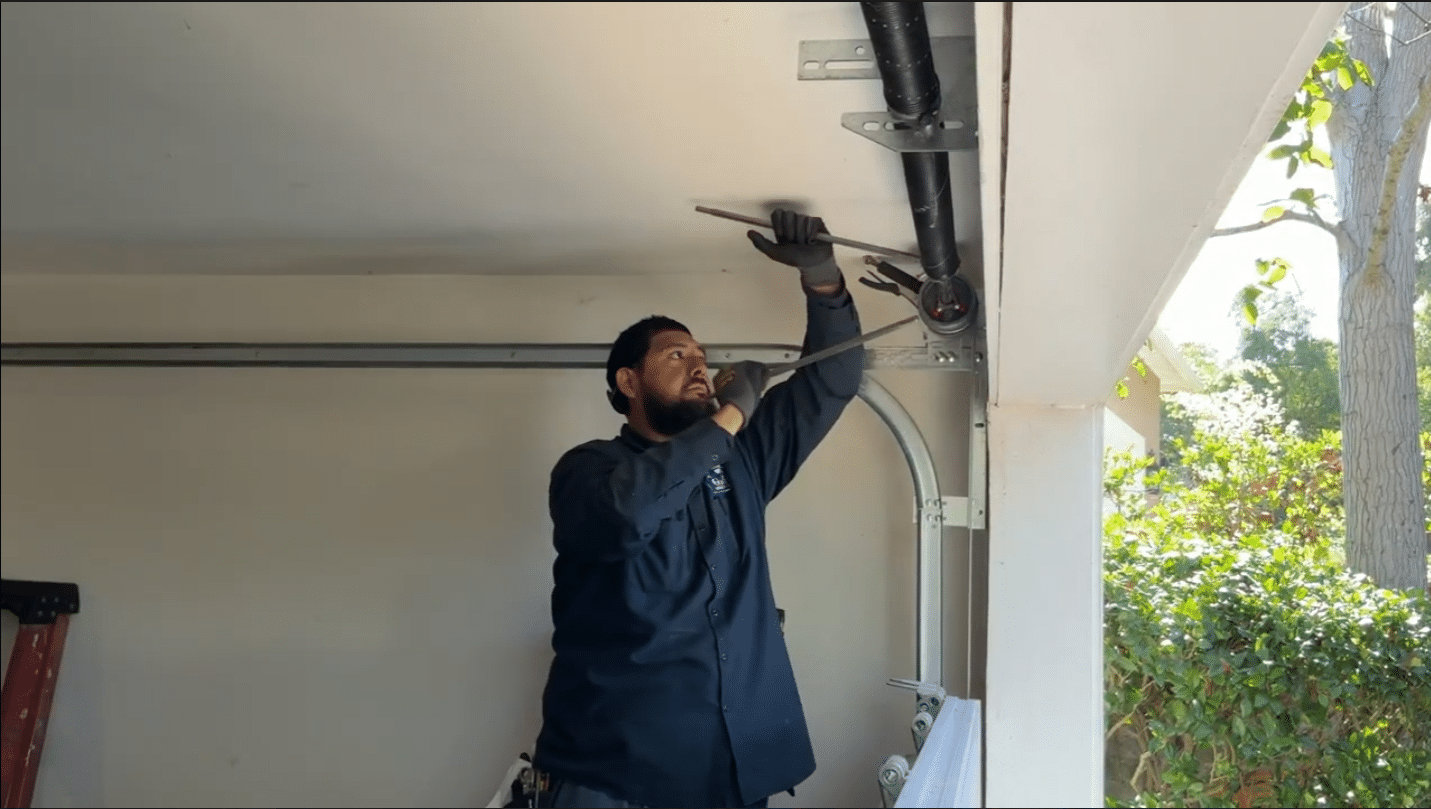
Pressing the button and getting zero response from your garage door is one of those frustrating moments that can throw off your entire day. Whether it happened out of nowhere or the door has been acting up for a while, the cause is usually something specific and identifiable.
In Anaheim, CA, garage doors take a beating from the heat, dust, and dry Santa Ana winds. Those conditions wear down components faster than most homeowners realize. Staying on top of garage door maintenance is one of the best ways to catch these issues early. The good news is that most problems follow a pattern, and knowing what to look for puts you one step closer to getting that door moving again.
What Causes a Garage Door to Stop Working?
Quick Answer for Search: The most common reasons a garage door won’t open include dead remote batteries, misaligned safety sensors, broken torsion springs, a disconnected trolley, power outages, motor failure, damaged tracks, and snapped cables. In Anaheim, CA, heat and dust speed up wear on these parts. Some issues are safe to handle on your own, while others require a licensed garage door technician.
Cold weather brings its own set of problems, too. Check out “Why Won’t My Garage Door Open in Cold Weather?“ to learn more.
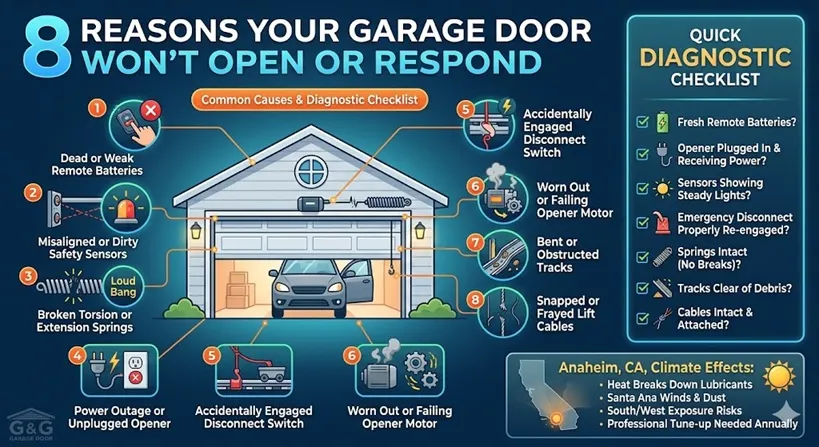
8 Reasons Your Garage Door Won’t Open or Respond
1. Dead or Weak Remote Batteries
This is the number one reason homeowners call for help, only to find out the fix costs less than two dollars. A remote that suddenly stops working does not always mean something is broken with the opener itself.
What to Check
Start by pressing the wall-mounted button inside the garage. If the door opens from there but not from the remote, the problem is with the remote, not the opener system. Check if the remote’s LED light flashes when the button is pressed. No light at all usually points to a dead battery.
What to Do
Replace the batteries with the correct type, which is usually a CR2032 coin battery or standard AA, depending on the brand and model. After swapping the batteries, test the remote again. If it still does not work with fresh batteries, the remote may need to be reprogrammed to the opener or replaced entirely.
How to Avoid This Problem
Keep a spare set of batteries stored near the garage. Most remotes give a subtle warning before fully dying, such as requiring multiple button presses to get a response. That is the signal to change the batteries before the door stops responding altogether.
If the batteries are not the issue, the problem could be something more serious. Read “Is a Broken Spring Why Your Garage Door Won’t Open?“ to find out if that could be what is going on.
2. Misaligned or Dirty Safety Sensors
Every garage door built after 1993 is required by law to have safety sensors installed near the base of the tracks. One sensor sends an infrared beam across the opening, and the other one receives it. If anything disrupts that beam, the door will not close, and in some cases, will not open either.
This is a safety feature working exactly as designed, but it can feel like a malfunction when it happens unexpectedly.
What to Check
Look at both sensors near the bottom of the door tracks. Each one should have a steady indicator light. A green light typically means the receiving sensor is aligned and working. An amber or yellow light on the sending side should also be steady. If either light is blinking or completely off, there is an alignment or obstruction issue.
Also, check the lens of each sensor for dust, dirt, or spider webs, which are extremely common in Anaheim garages during dry and windy seasons.
What to Do
Wipe each sensor lens gently with a clean, dry cloth. Carefully adjust the angle of the misaligned sensor until both lights become steady. Confirm that nothing is sitting in the path between the two sensors, including tools, boxes, garden equipment, or a bike tire.
How to Avoid This Problem
Add sensor cleaning to a seasonal maintenance routine. Anaheim’s dry climate and frequent dust make sensor lenses dirty faster than in more humid regions. A quick wipe-down every few months takes about 30 seconds and prevents a lot of headaches.
Sensor problems can be tricky to diagnose on your own. For a deeper look at what could be going on, check out “Are Misaligned Sensors Why Your Garage Door Won’t Open?“
3. Broken Torsion or Extension Springs
Broken springs are one of the most common and most serious reasons a garage door suddenly refuses to open. The springs are responsible for doing most of the heavy lifting every time the door moves. Without them working properly, the opener motor does not have enough strength to raise the door on its own.
What to Check
Look at the large horizontal spring mounted above the door opening. This is the torsion spring. If it is broken, there will be a visible gap or separation somewhere along its length. For doors with extension springs, those run along the sides of the track and will look slack or completely detached if broken.
Many homeowners first notice a broken spring because of a loud bang coming from the garage, often described as sounding like a firecracker or a gunshot. That sound is the spring snapping under tension.
What to Do
Do not attempt to operate the door if a spring is broken. Forcing the opener to run with a broken spring puts extreme stress on the motor and can cause additional damage. More importantly, do not try to replace garage door springs without professional training. These springs are under hundreds of pounds of tension and can cause serious injury if handled incorrectly.
How to Avoid This Problem
Garage door springs have a life expectancy of roughly 10,000 cycles. One cycle equals one full open and one full close. For a household that uses the garage door four times a day, that works out to about seven years before the springs are near the end of their lifespan. Scheduling an annual inspection lets a technician catch early signs of wear before a spring fails without warning.
4. Power Outage or Unplugged Opener
It sounds too simple, but a garage door opener with no power will not respond to anything, including the remote, the wall button, or the keypad.
What to Check
Locate the outlet near the ceiling where the opener motor unit is plugged in. Confirm the unit is fully plugged in and that the outlet itself is working. Test the outlet by plugging in a lamp or phone charger. If the outlet has no power, check the home’s electrical panel for a tripped circuit breaker.
What to Do
Reset the tripped breaker or plug the opener back into a working outlet. After a power outage, some opener models will also require the remote or keypad to be reprogrammed before they respond again.
How to Avoid This Problem
Consider upgrading to a garage door opener that includes a battery backup. This feature is especially useful in Anaheim during Santa Ana wind events, which can knock out neighborhood power for several hours at a time.
5. Accidentally Engaged Disconnect Switch
Every garage door opener includes a red emergency disconnect cord that hangs from the trolley on the rail. This cord exists so the door can be opened manually during a power outage. But if that cord gets pulled by accident, the door will not respond to the opener until it is reconnected.
What to Check
Look up at the trolley carriage on the overhead rail. The trolley is the part that connects the opener arm to the door. If the disconnect cord is pulled, the trolley will no longer be connected to the drive mechanism.
What to Do
Pull the disconnect cord toward the door rather than straight down. This should cause the trolley to re-engage with a click. Open and close the door manually once to confirm it moves freely, then test the opener again.
How to Avoid This Problem
Avoid storing anything by hanging it on the red disconnect cord. Items brushing against it or catching on it during daily garage activity are a common way it gets pulled without anyone realizing it.
6. Worn Out or Failing Opener Motor
Garage door openers are not built to last forever. Most units have a realistic lifespan of 10 to 15 years with regular use and basic maintenance. As the motor and circuit board age, performance declines before the unit fails completely.
What to Check
Press the button and listen carefully. A humming noise with no door movement usually means the motor is receiving power but is struggling to drive the mechanism. No sound at all suggests either a power problem or a completely failed motor board.
Take note of the opener’s age. If the unit is more than 12 years old and issues are becoming more frequent, the cost of repeated repairs can quickly outpace the cost of a new unit.
What to Do
Have a local garage door technician in Anaheim inspect the motor and circuit board. In many cases, replacing an aging opener entirely is the smarter financial decision compared to patching an old unit that will continue to have problems.
How to Avoid This Problem
Lubricate the drive mechanism once a year using a silicone-based or lithium grease spray. Keep the door itself balanced and the springs in good shape to reduce the strain the motor has to handle on every cycle.
7. Bent or Obstructed Tracks
The metal tracks on either side of the garage door guide the rollers as the door travels up and down. A dent, bend, or blockage in either track can stop the door mid-movement or prevent it from opening at all.
What to Check
Inspect both tracks visually from top to bottom. Look for any visible bends, dents, or gaps in the rail. Check for debris, dried grease buildup, or small objects lodged inside the track channel. A door that moves a few inches and then stops is a strong signal that a track issue is present.
What to Do
Remove any obvious debris from the tracks manually. Minor bends can sometimes be carefully tapped back into shape, but significant track damage should be assessed and repaired by a professional to ensure the door remains safe and balanced.
How to Avoid This Problem
Clean and lubricate the tracks every six months using a silicone-based spray. Avoid using WD-40 on garage door tracks since it attracts dust and can gum up over time. Also, be careful when parking or moving items in the garage, as even a minor impact from a vehicle bumper or a falling ladder can dent a track enough to cause problems.
8. Snapped or Frayed Lift Cables
The lift cables work alongside the springs to move the door smoothly and safely. Each cable runs from the bottom bracket on the door up to the drum near the ceiling. When a cable snaps or slips off the drum, the door can hang unevenly, jam, or refuse to move at all.
What to Check
Look at the cables running along both sides of the door near the bottom corners. A broken cable will appear slack, dangling, or completely disconnected. A frayed cable may still be in place but will show visible wire separation or unraveling. If the door looks uneven or sits at an angle, a cable problem is very likely the cause.
What to Do
Stop using the door immediately if a cable is broken or visibly frayed. Operating the door in this condition can cause the door to fall, damage the opener, or create a safety hazard.
How to Avoid This Problem
Have the cables inspected during annual maintenance visits. Catching fraying early allows for a planned replacement rather than an emergency repair. Cables that are approaching the end of their life will often show visible signs of wear before they snap completely.
Quick Diagnostic Checklist
Before calling a technician, run through this quick checklist to narrow down the problem:
- Are the remote batteries fresh and recently replaced?
- Is the opener plugged in and receiving power?
- Are both safety sensors showing steady lights?
- Is the emergency disconnect cord properly re-engaged?
- Do the springs look intact with no visible gap or break?
- Are both tracks clear of debris and obstructions?
- Are the cables intact and attached to both sides of the door?
- How old is the opener? Units older than 10 to 12 years may be nearing the end of their life.
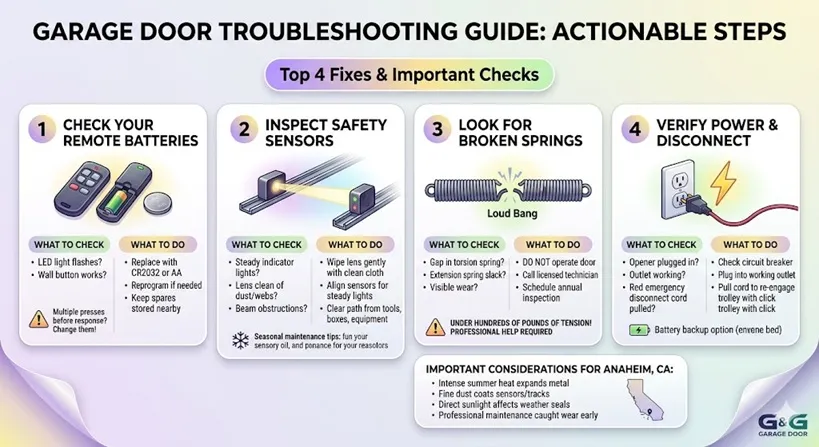
Why Anaheim Homeowners Deal With This More Than They Expect
The climate in Anaheim, CA, plays a real role in garage door performance. Summer temperatures regularly push into the 90s, which causes metal components to expand and lubricants to break down faster. The dry Santa Ana winds that blow through the region coat sensors, tracks, and rollers with fine dust and debris. Homes with garages that face south or west are also exposed to direct afternoon sunlight, which can warp weather seals and cause subtle changes in sensor alignment over time.
Scheduling a professional tune-up at least once a year, ideally in the spring before peak summer heat, is one of the most practical things an Anaheim homeowner can do to keep a garage door running reliably. A trained technician can spot wear patterns specific to the local climate and catch small problems before they turn into costly repairs.
Do Not Ignore a Garage Door That Refuses to Open
A garage door that will not open is more than an inconvenience. It can be a sign of a component that is close to failing completely, and in some cases, it is a safety issue that needs immediate attention. Not every fix is a DIY job. Replacing batteries and cleaning sensors are perfectly reasonable tasks for any homeowner, but broken springs, snapped cables, bent tracks, and motor failures all carry risks that require proper tools, training, and experience to handle safely.
For homeowners in Anaheim, CA, and the surrounding communities, reaching out to a trusted local garage door company is the fastest way to get a professional diagnosis and get the door operating safely again. In some situations, a full garage door replacement may be the safest and most cost-effective solution. A qualified technician who understands the local climate and the wear patterns that come with Southern California conditions can make a big difference in both the quality of the repair and how long that repair holds up over time.
The Right Team Makes All the Difference
That is exactly what G & G Garage Door brings to every job. Serving Anaheim and the surrounding Southern California communities, we have built a reputation for honest assessments, quality workmanship, and repairs that actually last. Whether the issue is a broken spring, a failing opener, or something that has been acting up for weeks, our team knows how to get to the root of the problem fast and fix it right the first time. Do not wait for a small problem to turn into a costly repair. Contact us today or give us a call, and let us get your garage door working safely again.
Frequently Asked Questions
[sp_easyaccordion id=”10842″]