





You press the button. The garage door groans, starts to move, and then stops. Or worse, it does not move at all.
If you are an Anaheim homeowner dealing with a garage door that refuses to open or close all the way, the problem might not be the motor, the remote, or even the springs. A lot of the time, the real culprit is something far simpler: misaligned safety sensors.
These small devices, usually mounted a few inches off the ground on both sides of your garage door, are designed to keep your family, pets, and belongings safe. But when they fall out of alignment, and they do more often than most people realize, they can bring your entire garage door system to a complete stop. Staying on top of garage door maintenance is one of the best ways to catch sensor issues before they turn into bigger problems.
Quick Answer: Yes, misaligned garage door sensors are one of the most common reasons a garage door will not open or close. When the sensors on each side of the door cannot detect each other, the opener shuts down as a safety measure. Signs include blinking lights, the door reversing immediately after moving, or no movement at all.
What Are Garage Door Sensors and Why Do They Matter?
Before getting into the list, it helps to understand what these sensors actually do, because knowing the “why” makes it much easier to understand why alignment matters so much.
Most modern garage doors, and all garage doors installed after 1993, thanks to a federal safety law, come equipped with photoelectric safety sensors, also called photo eyes. There are two of them, one on each side of the door, mounted close to the ground.
One sensor sends out an invisible infrared beam. The other one receives it. As long as that beam stays unbroken, the garage door knows the path is clear and operates normally. The moment something interrupts that beam, whether it is a toy, a pet, a trash can, or a sensor that has been knocked slightly out of position, the door stops or refuses to move.
It is a smart safety feature. But it is also a surprisingly easy one to accidentally disrupt.
For a bigger picture of what could be going on beyond the sensors, the blog “Garage Door Won’t Open or Respond? Here’s What’s Going Wrong” covers other common causes worth knowing about.
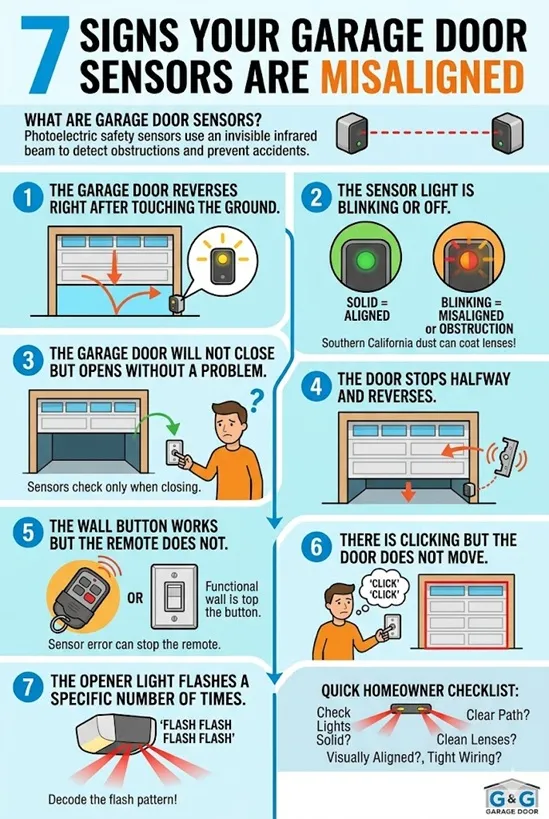
7 Signs Your Garage Door Sensors Are Misaligned
Here are the most common warning signs that your sensors are the problem. If any of these sound familiar, it is worth checking the sensors before assuming something bigger is broken.
1. The Garage Door Reverses Right After Touching the Ground
This is one of the most classic signs of a sensor problem. The button gets pressed, the door comes down, and the second it reaches the floor, it bounces right back up.
When sensors are out of alignment, the opener reads the situation as a possible safety hazard, even when nothing is in the way. It reverses automatically to prevent damage or injury. The system is working exactly as designed, just for the wrong reason.
What to check: Look at both sensors. If either light is blinking, flickering, or completely off, alignment is the likely issue.
If the door is reversing during colder months, temperature could also be playing a role. “Why Won’t My Garage Door Open in Cold Weather?” is a helpful read for Anaheim homeowners dealing with that specific situation.
2. The Sensor Light Is Blinking or Off
Each sensor has a small indicator light. On most brands, including LiftMaster, Chamberlain, and Genie, the lights communicate the following:
- Solid green or solid amber means the sensors are aligned and communicating properly
- Blinking or no light means there is a misalignment or an obstruction blocking the beam
If one of those lights is blinking right now, that sensor is sending a warning signal that something is wrong.
Tip for Anaheim homeowners: Southern California’s dry and dusty conditions, especially during Santa Ana wind season, can coat sensor lenses with a thin layer of debris that disrupts the beam even when the physical alignment looks fine. Wiping both lenses gently with a clean, dry cloth is always a smart first step.
If the sensor lights check out but the door still will not move, the problem might be mechanical. “Is a Broken Spring Why Your Garage Door Won’t Open?” is worth checking out to rule out that possibility.
3. The Garage Door Will Not Close but Opens Without a Problem
This is a detail that confuses a lot of homeowners. The door opens perfectly fine, but refuses to close.
This happens because the opener uses the sensor beam mainly as a safety check during the closing cycle. Opening the door does not require the beam to be active. But the moment a close command is given, the system checks whether both sensors are communicating. If they are not, the door will not come down.
This is actually the safety system doing its job correctly. However, it also means a sensor problem tends to show up more obviously when closing than when opening.
4. The Door Stops Halfway and Reverses
If the garage door starts to close, makes it partway down, and then suddenly reverses back up, do not assume it is a spring or track problem right away.
A misaligned sensor can cause this mid-cycle reversal, too. Vibration from the door moving can shift a loose sensor just enough to break the beam mid-cycle. This is fairly common in older Anaheim homes where garage doors have been running for many years, and the sensor brackets have gradually loosened over time.
5. The Wall Button Works but the Remote Does Not
This one surprises a lot of people. In some opener systems, a sensor error will cause the remote to stop responding while the wall-mounted button still functions. If the remote suddenly seems dead but the wall button still works, the sensors should be checked before replacing the remote or assuming the opener is broken.
6. There Is Clicking but the Door Does Not Move
Some opener models will click or attempt to cycle when the button is pressed, but will not actually engage the door if a sensor fault is detected. That clicking sound is the motor trying to get clearance from the safety system and failing to receive it.
7. The Opener Light Flashes a Specific Number of Times
This is something most homeowners do not know about. Many modern garage door openers use a diagnostic flash code, where the light on the opener unit blinks a certain number of times to signal a specific type of problem. Four flashes on a LiftMaster unit, for example, often point directly to a sensor issue.
Checking the opener manual or looking up the model number online to decode the flash pattern can save both time and a service call.
Why Do Garage Door Sensors Fall Out of Alignment?
Understanding what causes the problem makes it easier to prevent it from happening again. Here are the most common reasons sensors shift out of position:
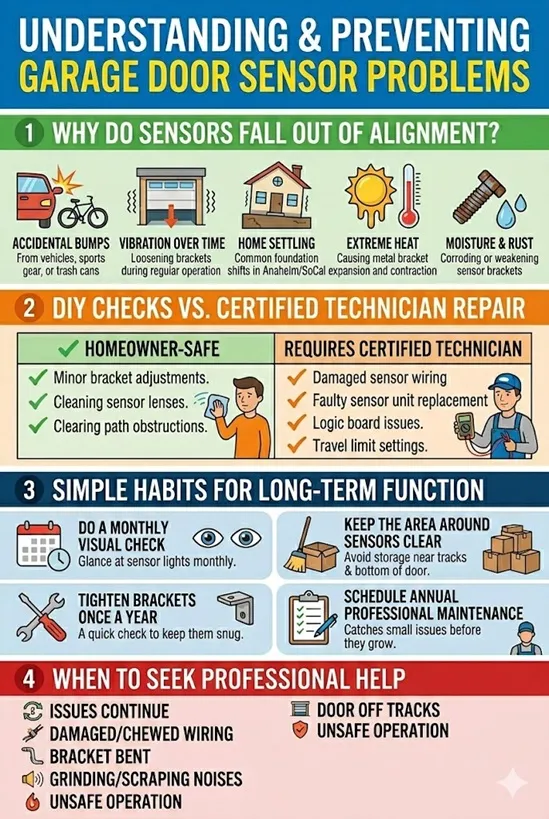
- Accidental bumps: A car door, a bicycle, or a misplaced garbage can clipping the sensor bracket is enough to knock it off angle
- Vibration over time: Every open and close cycle sends vibration through the entire door system. Over months and years, this slowly loosens sensor brackets
- Home settling: In Anaheim and throughout Southern California, homes settle gradually. Even minor foundation shifts can affect door frames and throw off sensor alignment
- Extreme heat: Anaheim temperatures regularly climb into the 90s during summer. Heat causes metal brackets to expand and contract, which can gradually shift sensor angles
- Moisture and rust: While Anaheim has a dry climate, coastal humidity still reaches inland areas. Rust on sensor brackets can lock them in a bad position or make them brittle over time
What to Check Before Calling a Technician
Before picking up the phone, here are a few simple checks that any homeowner can do safely on their own:
- Check the sensor lights: Are both lights solid? Or is one blinking or completely off?
- Look for physical obstructions: Is anything blocking the beam between the two sensors? Even a spider web stretched across the path can cause a fault.
- Clean the lenses: Gently wipe both sensor lenses with a soft, dry cloth. Dust and grime are invisible troublemakers that are easy to overlook.
- Check the alignment visually: Both sensors should be aimed directly at each other. If one is angled up, down, or sideways, that is the issue.
- Inspect the wiring: Look for any wires that appear pinched, frayed, or disconnected from the sensor unit.
- Watch for sunlight interference: Direct sunlight hitting a sensor lens can temporarily disrupt the beam. This is more common during late afternoon hours when the sun angle shifts. Some west-facing Anaheim garages experience this seasonally, especially in the spring and fall.
Can This Be Fixed Without a Professional?
Here is an honest answer: minor alignment adjustments are something most homeowners can handle carefully. Anything beyond that is a job for a professional.
Loosening a wing nut and gently rotating a sensor bracket back into position is a straightforward task. If both lights go solid and the door starts working again, the fix is complete.
But if the alignment has been checked, the lenses have been cleaned, obstructions have been cleared, and the door still is not working, the problem could be something more involved:
- Damaged sensor wiring
- A faulty sensor unit that needs full replacement
- A problem with the opener’s logic board
- An issue with the door’s travel limit settings
These repairs require a trained garage door technician. Attempting to rewire or replace components without the right experience can lead to bigger and more expensive problems, and in some cases, serious safety risks.
Average cost in the Anaheim area: Most homeowners spend an average amount for professional sensor repair or replacement, including parts and labor. It is a relatively affordable fix compared to spring replacement or a full opener overhaul, and getting it done the first time correctly is always the smarter investment.
How to Prevent Sensor Misalignment Going Forward
Prevention is always easier than repair. Here are some practical habits that keep garage door sensors working correctly long-term:
- Do a monthly visual check: Spend 30 seconds once a month glancing at the sensor lights. If both are solid, the system is good.
- Keep the area around sensors clear: Nothing should be stored near the bottom of the garage door tracks. That zone needs to stay open at all times.
- Tighten brackets once a year: An annual check of sensor mounting brackets ensures they stay snug. It takes a screwdriver and about two minutes.
- Schedule annual professional maintenance: A yearly tune-up from a qualified technician catches small issues, like slowly drifting sensors, before they turn into real problems. This is especially valuable for older Anaheim homes where garage systems have been running for a decade or more.
- Be careful during garage cleaning: When sweeping out or pressure washing the garage floor, avoid bumping the sensors or directing water spray at the sensor units.
When to Call a Garage Door Professional in Anaheim
Do not wait for the situation to get worse. Reaching out to a local garage door technician makes sense when:
- The sensors have been checked and cleaned, but the problem continues
- The sensor wiring looks damaged or chewed (rodents are a real issue in some Anaheim neighborhoods)
- The sensor bracket is physically bent or broken and cannot hold its position
- The door is making grinding, scraping, or popping noises alongside the sensor problem
- The door has come off the tracks
- Working near garage door components does not feel safe or comfortable
A qualified Anaheim garage door technician can diagnose the issue quickly, walk through the available options clearly, and get the door back to working safely, usually in a single visit.
What It All Comes Down To for Anaheim Homeowners
Misaligned garage door sensors are one of those problems that can feel serious but often have a simple solution. The key is knowing what to look for and knowing when a problem needs more than a quick adjustment.
For Anaheim homeowners dealing with a blinking sensor light or a door that refuses to cooperate, starting with the basics is the right move. Check the lights, clear any obstructions, wipe the lenses, and see if the alignment looks off visually. The problem might be solved in under ten minutes.
And if it is not? Do not force it. A garage door is one of the largest moving parts in any home, and getting a professional involved is always the right call when the basics do not work. In some cases, repeated sensor problems can be a sign that the system is aging, and a professional can help determine whether a repair is enough or whether a garage door replacement makes more sense in the long run.
Leave It to the Experts
That is where G & G Garage Door comes in. Serving Anaheim and the surrounding Orange County area, we have built a strong reputation for honest, reliable, and expert garage door service. Whether it is a sensor alignment issue, a full opener replacement, or a repair that needs same-day attention, our team brings the experience and knowledge to get the job done right the first time, every time. Do not let a garage door problem slow down your day. Contact us today or give us a call and get your door working safely again.
Frequently Asked Questions
[sp_easyaccordion id=”10859″]